Learning Objectives:
• Practise the skills learnt in class
• Develop creative thinking skills
• Develop independent working habits
• Learn to problem-solve
• Learn to take risks
• Develop creative thinking skills
• Develop independent working habits
• Learn to problem-solve
• Learn to take risks
What you will need:
Sketching paper (or your sketchbook), soft pencils (preferably 2B and 4B), colouring pencils, eraser, a pencil sharpener, coloured pencils, a black fine-liner pen, watercolour brushes, and anything else you choose to use
Conceptual Art Challenges
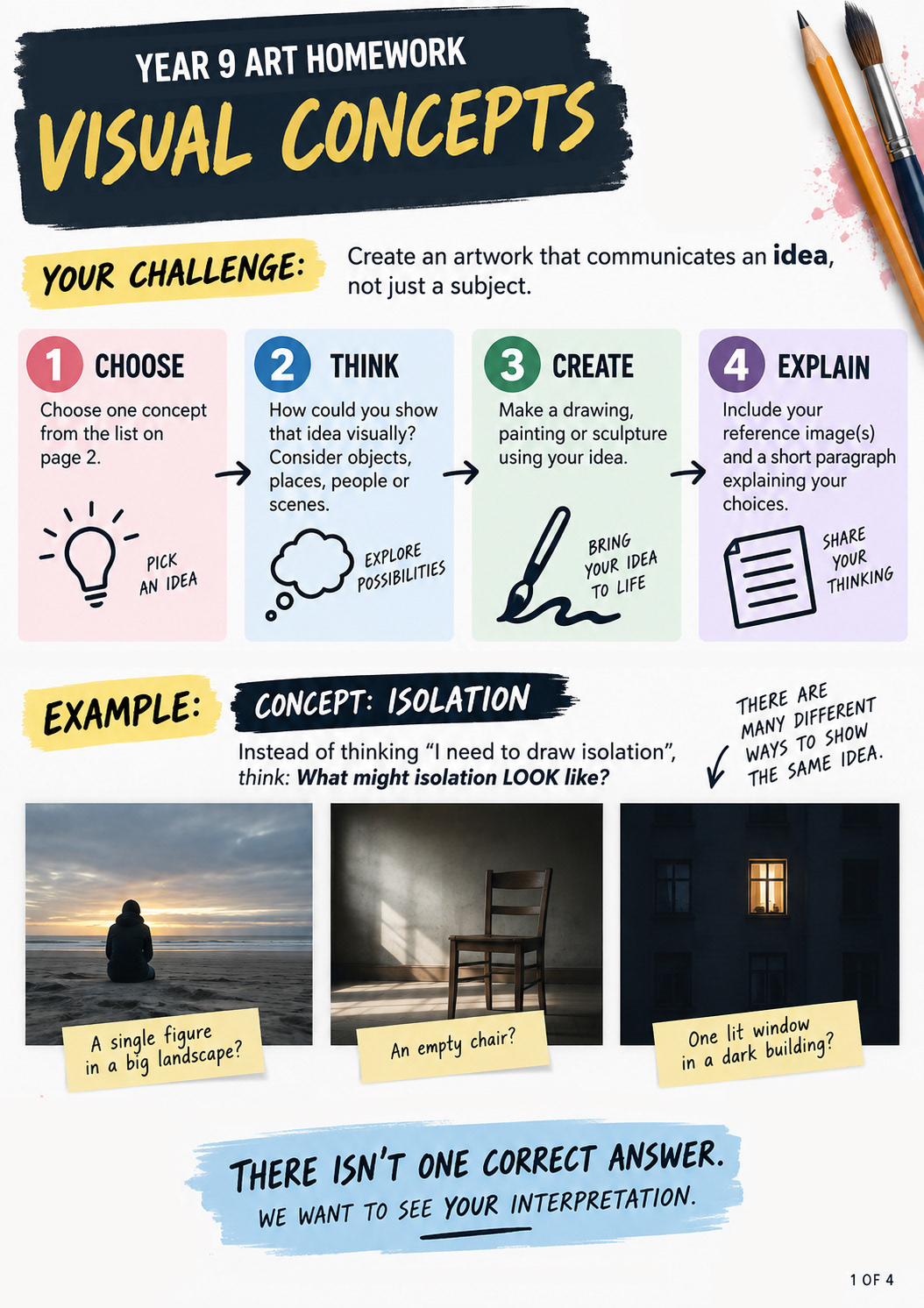
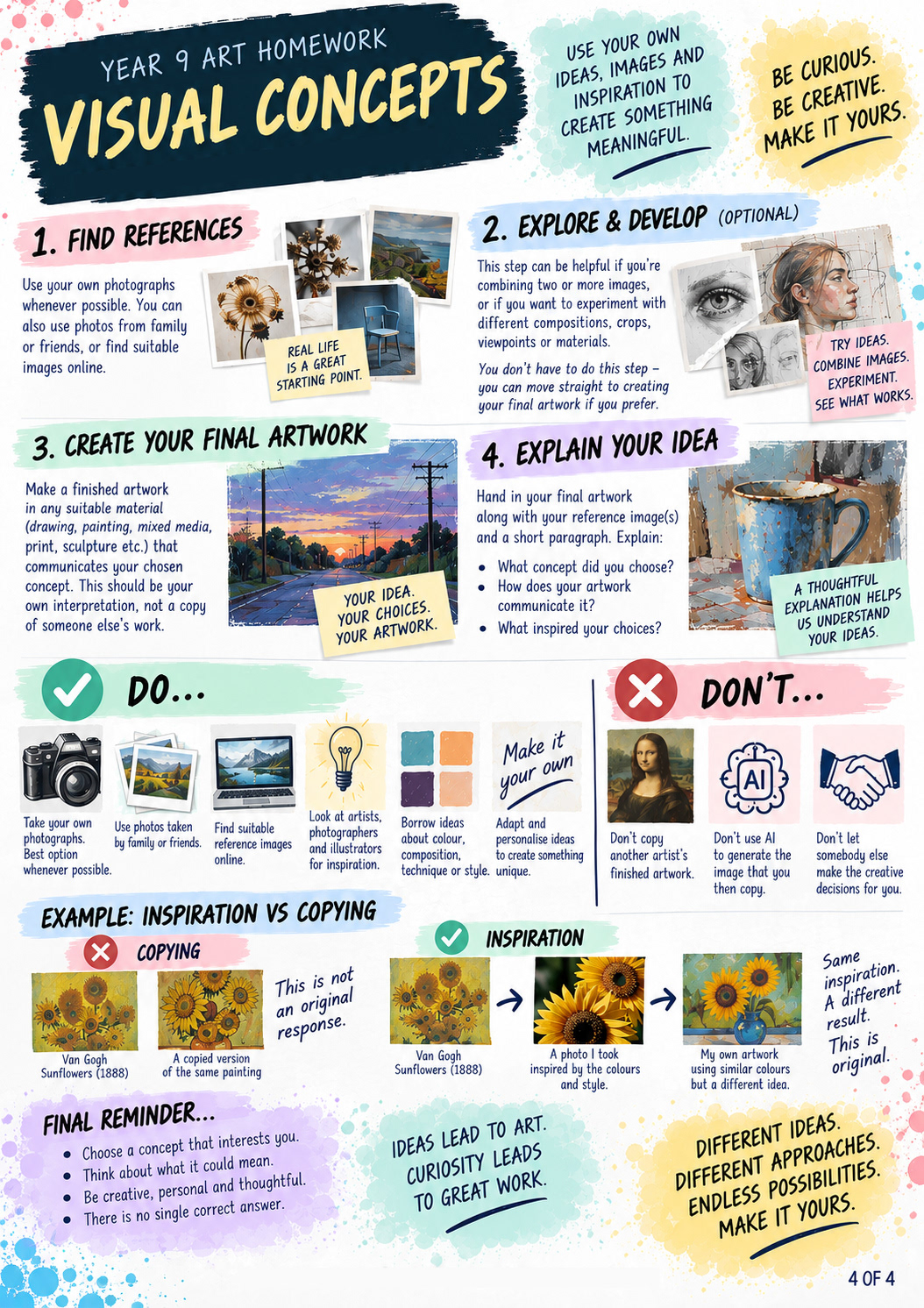
Throughout Year 9 you will complete four homework projects. Each project will explore a different idea or concept through a drawing, painting or sculpture of your choice.
Due:
• 9K: 13th October
• 9S: 16th October
• 9K: 13th October
• 9S: 16th October
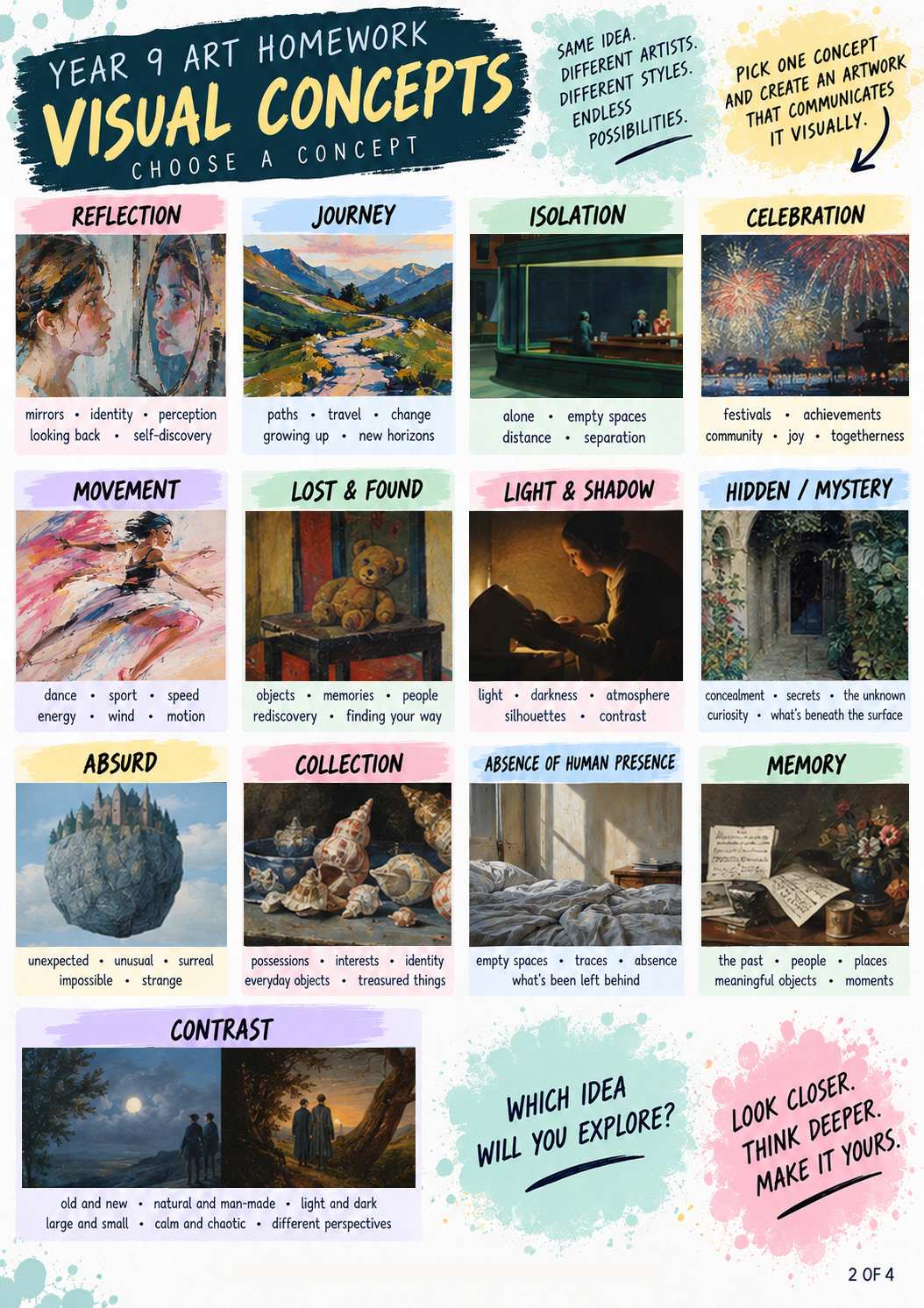
Unlike previous years, you will not be told what to draw. Instead, you will choose a concept from the list below and create an artwork that communicates your chosen idea visually.
Choose From:
Reflection
Reflection can be physical, such as a mirrored image, or emotional, involving self-awareness, memory and identity. What objects, places or symbols could help you explore the relationship between how things appear and what lies beneath the surface?
Reflection can be physical, such as a mirrored image, or emotional, involving self-awareness, memory and identity. What objects, places or symbols could help you explore the relationship between how things appear and what lies beneath the surface?
Journey
A journey may involve travelling from one place to another, but it can also describe personal growth, change or discovery. Consider how you might communicate progress, transition or direction without simply showing a mode of transport.
A journey may involve travelling from one place to another, but it can also describe personal growth, change or discovery. Consider how you might communicate progress, transition or direction without simply showing a mode of transport.
Isolation
Isolation can evoke feelings of solitude, peace, vulnerability or distance from others. Consider how space, scale and atmosphere might influence the viewer's emotional response.
Isolation can evoke feelings of solitude, peace, vulnerability or distance from others. Consider how space, scale and atmosphere might influence the viewer's emotional response.
Celebration
Celebration is often linked to joy, achievement, culture and shared experiences. What colours, compositions or visual clues could communicate a sense of occasion and excitement?
Celebration is often linked to joy, achievement, culture and shared experiences. What colours, compositions or visual clues could communicate a sense of occasion and excitement?
Movement
Movement brings life and energy to an artwork, whether through people, animals, objects or natural forces. How might you create the feeling of motion in a still image?
Movement brings life and energy to an artwork, whether through people, animals, objects or natural forces. How might you create the feeling of motion in a still image?
Lost & Found
Something lost and found can be a physical object, a memory, a relationship or a part of yourself. What story could you tell about absence, discovery or reconnection?
Something lost and found can be a physical object, a memory, a relationship or a part of yourself. What story could you tell about absence, discovery or reconnection?
Shadows
Shadows can reveal as much as they conceal, transforming ordinary scenes into something dramatic or unexpected. How might light and shadow become the main subject of your artwork rather than simply supporting it?
Shadows can reveal as much as they conceal, transforming ordinary scenes into something dramatic or unexpected. How might light and shadow become the main subject of your artwork rather than simply supporting it?
Night
Night changes the way we experience familiar places, creating mystery, beauty and uncertainty. What mood, atmosphere or emotion might emerge when the world is seen after dark?
Night changes the way we experience familiar places, creating mystery, beauty and uncertainty. What mood, atmosphere or emotion might emerge when the world is seen after dark?
Hidden
Not everything is immediately visible; some things must be searched for, uncovered or imagined. How could your artwork encourage the viewer to look more closely and discover something they did not notice at first?
Not everything is immediately visible; some things must be searched for, uncovered or imagined. How could your artwork encourage the viewer to look more closely and discover something they did not notice at first?
Mystery
Mystery invites the viewer to ask questions and imagine stories beyond what they can see. What information might you deliberately leave out in order to create intrigue and curiosity?
Mystery invites the viewer to ask questions and imagine stories beyond what they can see. What information might you deliberately leave out in order to create intrigue and curiosity?
Absurd
The absurd challenges our expectations by combining ideas in unusual or impossible ways. What unexpected combination of objects, places or events could make the viewer stop and think?
The absurd challenges our expectations by combining ideas in unusual or impossible ways. What unexpected combination of objects, places or events could make the viewer stop and think?
Collection
Collections can reveal interests, memories, identities and obsessions. How might a group of objects tell us something about a person without showing the person themselves?
Collections can reveal interests, memories, identities and obsessions. How might a group of objects tell us something about a person without showing the person themselves?
Absence of Human Presence
Even when people are not visible, traces of their lives and actions often remain. What signs, objects or spaces could suggest that somebody has just left or is about to return?
Even when people are not visible, traces of their lives and actions often remain. What signs, objects or spaces could suggest that somebody has just left or is about to return?
Memory
Memories can be vivid, fragmented, nostalgic or unreliable. What objects, places or symbols could help you communicate a memory without showing the event itself?
Memories can be vivid, fragmented, nostalgic or unreliable. What objects, places or symbols could help you communicate a memory without showing the event itself?
Contrast
Contrast highlights differences and can create visual impact, tension or meaning. Which opposites interest you most, and how might you bring them together within a single image?
Contrast highlights differences and can create visual impact, tension or meaning. Which opposites interest you most, and how might you bring them together within a single image?
Do you have an amazing idea that doesn't fit under any of these themes? Go talk to Mr Lax!
What can I create?
You may create a drawing, painting or sculpture of any subject matter you wish, provided it is appropriate for school and does not contain nudity, violence or offensive content.
Think carefully about how your chosen subject matter can communicate your selected concept.
There is no single correct answer. The strongest responses are often the most personal and imaginative.
Reference Images
You must include a copy of the reference image(s) used to create your artwork.
Whenever possible, you are encouraged to take your own photographs rather than relying entirely on images found online. Original photographs often lead to more personal and successful outcomes and will be awarded extra marks.
Artist Inspiration
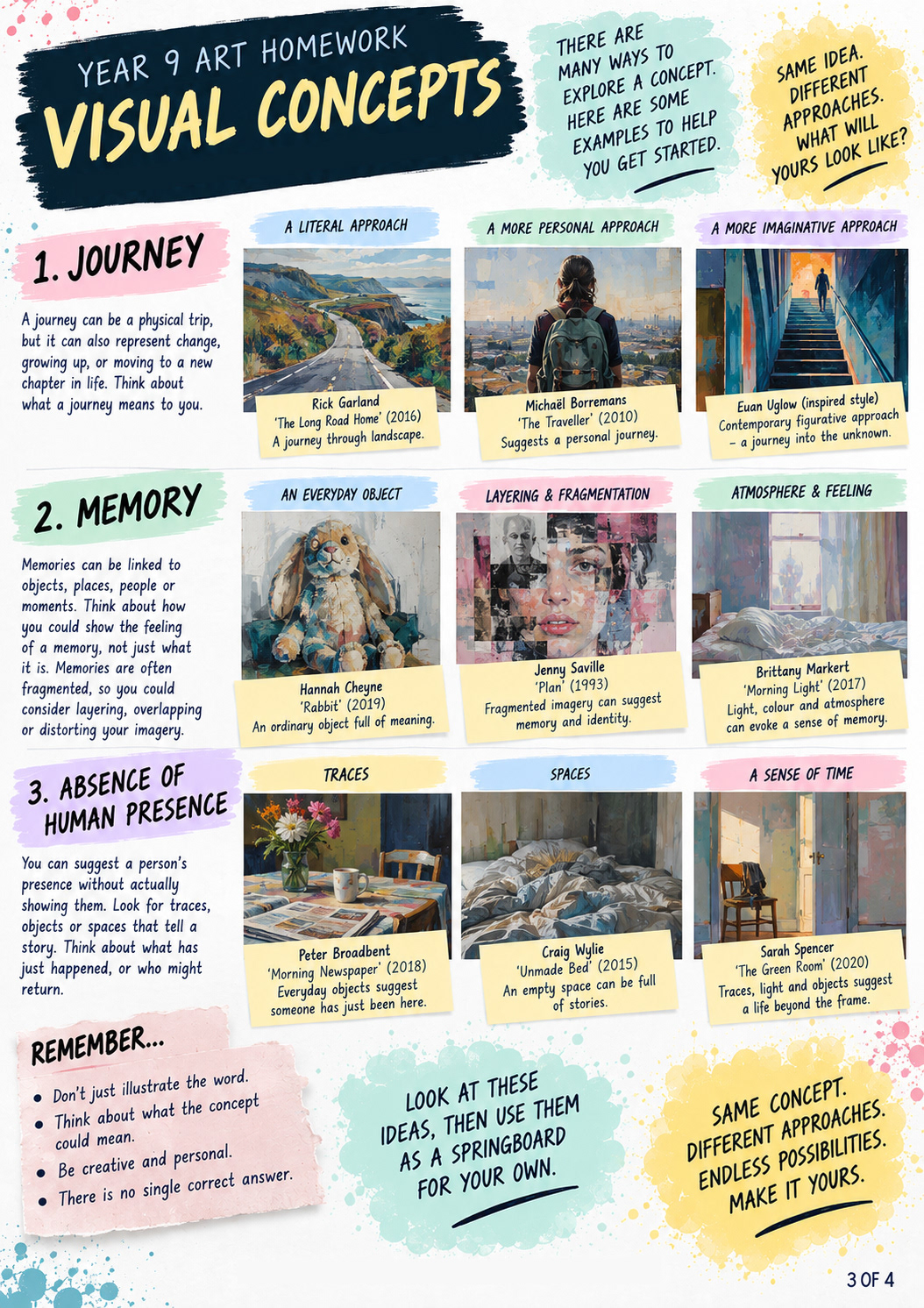
You are encouraged to look at the work of artists, illustrators and photographers for inspiration.
You might be inspired by:
You might be inspired by:
• Their use of colour
• Their drawing style
• Their composition
• Their lighting
• Their techniques or materials
• Their drawing style
• Their composition
• Their lighting
• Their techniques or materials
You should not copy an artist’s work, but allowing their style or approach to influence your own artwork can often strengthen your outcome.
Written Explanation
Alongside your artwork, write a very short paragraph explaining:
1. Which concept did you choose?
2. How does your artwork communicate that idea?
3. Which artist influences or personal reasons are behind your choice?
1. Which concept did you choose?
2. How does your artwork communicate that idea?
3. Which artist influences or personal reasons are behind your choice?
Assessment
Your homework will be assessed on:
• Technical skill and presentation.
• Use of tone, colour, texture and composition.
• Creativity and originality of your chosen concept.
• How successfully the artwork communicates the concept.
• The quality and suitability of the reference material used.
• Use of tone, colour, texture and composition.
• Creativity and originality of your chosen concept.
• How successfully the artwork communicates the concept.
• The quality and suitability of the reference material used.
Remember, a beautifully drawn artwork is only part of the challenge. The most successful pieces will combine strong technical skills with a clear and thoughtful visual idea. Achieving a balance between both is the goal.

Produce an entry for the Kingsley art competition over the Christmas holidays. The theme will be announced just before the October half-term.
Deadline: TBC
Personal Investigation Project
In this project, you will choose an artist who inspires you and delve into their work and life by answering a series of thought-provoking questions. This exercise will encourage you to develop your critical thinking, analytical skills, and personal artistic preferences.
Assignment 1: Your inspirations
Choose any artist who truly inspires you. It can be a historical figure or a contemporary artist, and they can work in any artistic medium (painting, sculpture, printmaking, mixed media, etc., but not photography, video or digital media).
I have provided you with a list of questions that delve into your personal thoughts and opinions about your chosen artist. These questions do not have easily searchable answers but rely on your own thoughtful interpretation, opinions and critical thinking.
The impact your artist has made on you:
• Select one artwork by your chosen artist that you find particularly captivating. Explain why it speaks to you and how it makes you feel.
• In your opinion, what emotions or messages do you think your chosen artist aimed to convey through their work?
• In your opinion, what emotions or messages do you think your chosen artist aimed to convey through their work?
Artistic styles:
• Consider an artist who worked in a similar style or time period as your chosen artist. How do they compare in terms of their artistic contributions and influences?
• If you were to create a piece of art inspired by your chosen artist, what elements or themes would you incorporate, what would you do differently, and why?
Societal influences:
• How do you perceive the impact of your chosen artist's work on the art world or society during their time?
• Reflect on whether your chosen artist's work challenges or reinforces conventional artistic norms. Explain your perspective.
Bonus question (optional and just for fun):
• Download the ‘Hello History’ app on your phone, pick an artist and ask them the following question about your artist, then write down their response:
“What do you like most about ______’s artwork and why?”
This app uses artificial intelligence so the answers are just a bit of fun and should not be taken too seriously!
Examples of artists:
Animals:
• Andreas Preis
• Ben Tolman
• Caroline Bletsis
• Chow Martin
• Christina Mrozik
• Denise Nestor
• Douglas Miller
• Franz Marc
• Henri Rousseau
• Sarah Matthews
• Ben Tolman
• Caroline Bletsis
• Chow Martin
• Christina Mrozik
• Denise Nestor
• Douglas Miller
• Franz Marc
• Henri Rousseau
• Sarah Matthews
Architecture:
• Aldo Rossi
• Andrew McKean
• Anthoni Gaudi
• Brett Amory
• CRW Nevinson
• Edward Hopper
• Foujita Tsuguharu
• Ian Murphy
• John Piper
• John Ruskin
• John Singer Sargant
• Andrew McKean
• Anthoni Gaudi
• Brett Amory
• CRW Nevinson
• Edward Hopper
• Foujita Tsuguharu
• Ian Murphy
• John Piper
• John Ruskin
• John Singer Sargant
Illustration:
• Adara Sanchez Anguiano
• Bao Pham
• Chalermphol Harnchakkham
• Chris Ofili
• Ernst Haeckel
• Frank Gonzales
• Jamie Hewlett
• Jean Dubuffet
• Joseph Loughborough
• Maurice Sendak
• Sara Blake
• Bao Pham
• Chalermphol Harnchakkham
• Chris Ofili
• Ernst Haeckel
• Frank Gonzales
• Jamie Hewlett
• Jean Dubuffet
• Joseph Loughborough
• Maurice Sendak
• Sara Blake
Dreams and Imagination:
• Alex Eckman-Lawn
• Dana Bunker
• Gosha Levochkin
• HR Giger
• Jeff Soto
• Jerry Uelsmann?
• Salvador Dali
• Dana Bunker
• Gosha Levochkin
• HR Giger
• Jeff Soto
• Jerry Uelsmann?
• Salvador Dali
Portraiture:
• Agnes Cecile
• Allison Torneros
• Camile Lescure
• Carravaggio
• Carne Griffiths
• Carolina Rodriguez Fuenmayor
• Christina Troufa
• Chuck Close
• David Adey
• Egon Shiele
• Esther Barend
• Filip Peraic
• Fiona Morley
• Frida Khalo
• Gustav Klimt
• Leonado da Vinci
• Lucian Freud
• MC Escher
• Michelangelo
• Paula Rego
• Vincent van Gogh
• Allison Torneros
• Camile Lescure
• Carravaggio
• Carne Griffiths
• Carolina Rodriguez Fuenmayor
• Christina Troufa
• Chuck Close
• David Adey
• Egon Shiele
• Esther Barend
• Filip Peraic
• Fiona Morley
• Frida Khalo
• Gustav Klimt
• Leonado da Vinci
• Lucian Freud
• MC Escher
• Michelangelo
• Paula Rego
• Vincent van Gogh
Sculpture:
• Anagram Bookshop
• Anthony Gormley
• Brian Mock
• Claes Oldenburg
• Derek Kinzett
• Heather Jansch
• Jennifer Collier
• Lisa Nilsson
• Natsumi Honda
• Peter Callessen
• Richard Sweeney
• Anthony Gormley
• Brian Mock
• Claes Oldenburg
• Derek Kinzett
• Heather Jansch
• Jennifer Collier
• Lisa Nilsson
• Natsumi Honda
• Peter Callessen
• Richard Sweeney
Landscapes:
• Claude Monet
• Alfred Sisley
• Allan Pendreigh
• Andrew McKean
• Armand Guillaumin
• David Hockney
• Heather Horton
• Kurt Jackson
• LS Lowry
• Wayne Thiebaud
• Alfred Sisley
• Allan Pendreigh
• Andrew McKean
• Armand Guillaumin
• David Hockney
• Heather Horton
• Kurt Jackson
• LS Lowry
• Wayne Thiebaud
Assignment 2: Image Analysis
Analyse one of the artists’ works by describing your own thoughts, observations and interpretations. Try to be as creative as you can by thinking 'outside of the box'.
· What does the image depict?
· What is the mood of the image? Consider the artist’s use of colour, the composition and the painting style.
· What do you think the image is trying to say? Is it telling a story or making a statement? Have a go at interpreting the image. Has something just happened or is something about to happen? You will have to use your imagination for this!
· Do you think anything in the image is symbolic of something? What is being represented?
· What are your own thoughts and opinions about the artwork?
· There is no right or wrong interpretation, so be as imaginative as you can.
· What is the mood of the image? Consider the artist’s use of colour, the composition and the painting style.
· What do you think the image is trying to say? Is it telling a story or making a statement? Have a go at interpreting the image. Has something just happened or is something about to happen? You will have to use your imagination for this!
· Do you think anything in the image is symbolic of something? What is being represented?
· What are your own thoughts and opinions about the artwork?
· There is no right or wrong interpretation, so be as imaginative as you can.
Try to include comments about the work’s content, context, composition/layout, mood/expression, colours, materials, style and techniques used. Offer more than one possible interpretation for the opportunity to access the higher marks.
Assignment 3: Experiments
Produce 3 or 4 detailed drawings or paintings, experimenting with the techniques and styles used by your chosen artist.
Each study should be a copy a section of an artwork, using appropriate materials, so that your studies are as similar to the artist’s work as possible. Each section should be completed using a different material. Remember, quality is more important than quantity.
Assignment 4: Final Piece
Produce a detailed drawing or painting in the same style as your chosen artist.
Your painting should be A3 or bigger, in colour and based on photographs you have taken.
· Your chosen artwork should be in the style of the artist you researched and analysed.
· Add as much detail as you can, and feel free to use any of the materials and techniques learnt in class.
· You may use any art materials you consider suitable.
· Try to fill the page as much as possible and use colour for the higher marks.
· Add as much detail as you can, and feel free to use any of the materials and techniques learnt in class.
· You may use any art materials you consider suitable.
· Try to fill the page as much as possible and use colour for the higher marks.
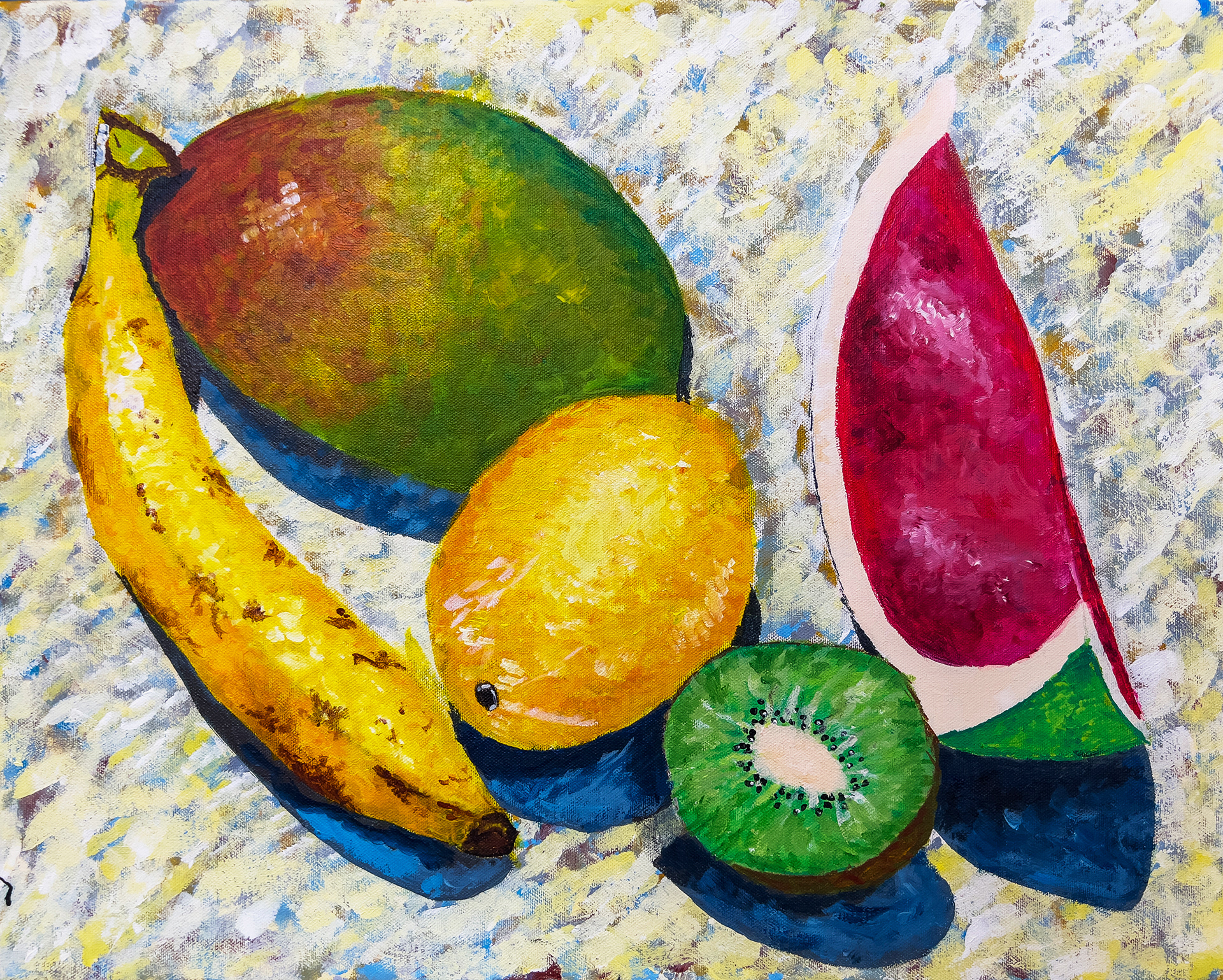
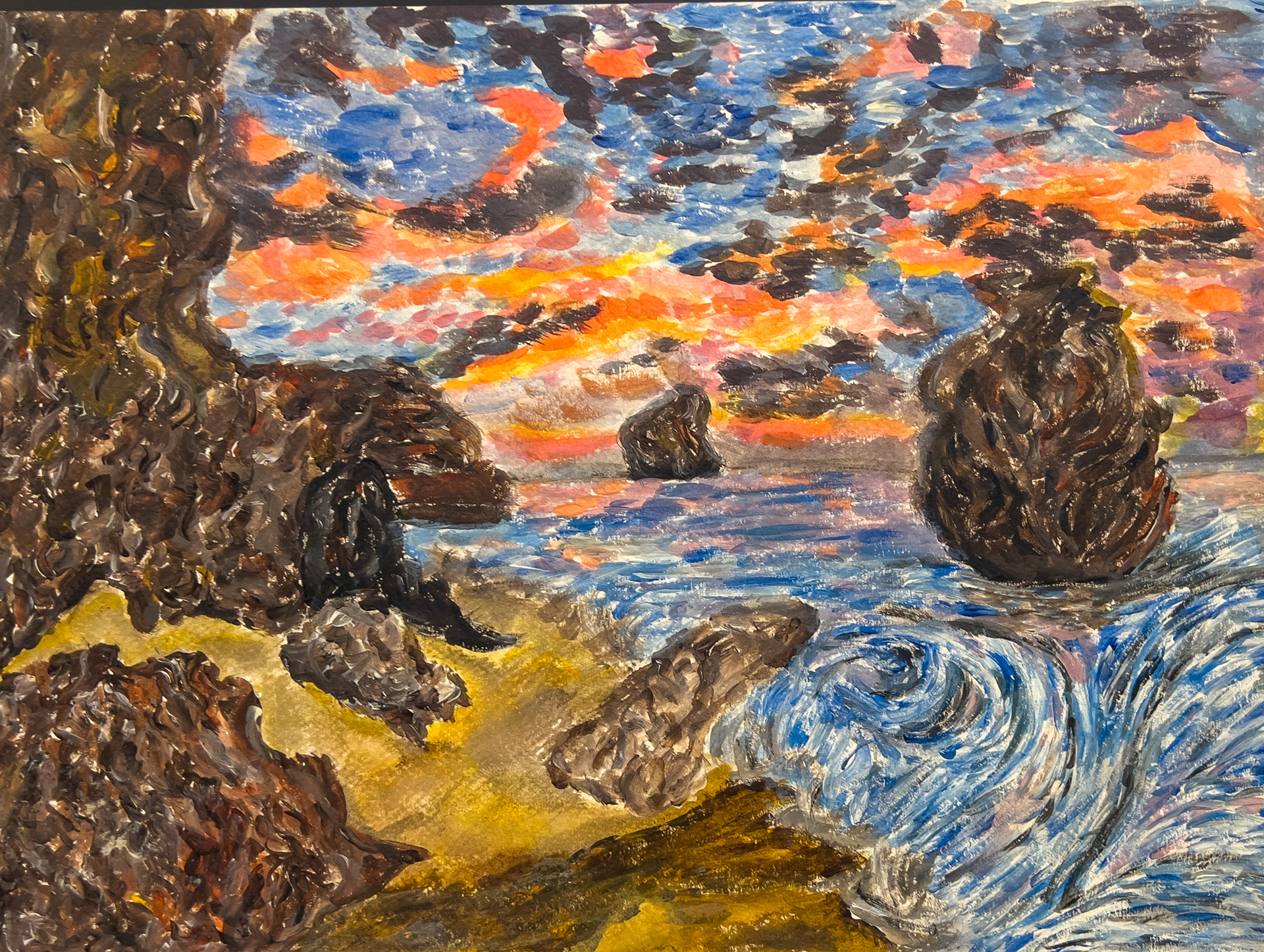
Examples of pieces by previous students:
Photography Project